What is Information Design?
Graphic design isn't just about making something look good or selling stuff people don't need. It must also effectively communicate with its target audience and help them gain a good understanding of a message.
That might be a brand communicating who an organisation is, its ethics and values; a campaign encouraging someone to act or donate funds; a publication sharing research; or an infographic making complicated but important information easier to grasp.
For purpose-led businesses, charities and educators, good communication can be particularly important, especially if it is to explain something complex, challenge the status quo, change behaviour, raise awareness or encourage people to make a positive difference.
Information design is an approach to graphic design that focuses on making information clear, understandable and accessible.
It involves thinking carefully about the information itself, the people who need to use it and how design can help them navigate, understand and act on it. We're constantly bombarded with information, so how it's presented can make a considerable difference.
For me, Graphic Information Design is part of Graphic Design. It's the foundation that has shaped how I approach my work throughout my career.
What does an Information Designer actually do?
A good graphic designer should make decisions about information:
What should people notice first?
What needs to stand out?
How should different pieces of information relate to each other?
What can be simplified?
What could be confusing?
And, perhaps most importantly, how can we make this easier for the audience?
My degree in Graphic Information Design provided a foundation for naturally thinking about these questions alongside the creative decisions. It's not about adding more information. It's about helping people make sense of the information that's already there.
And when you're communicating about climate change, biodiversity, social mobility, education, health or sustainable development, that's an important job.
Graphic Information Design is part of good graphic design.
Every piece of graphic design tells a story! A logo reflects who you are, showcasing your personality, values, and ethics. A campaign shares a message that aims to inspire action. Reports highlight evidence and findings, showing the impact of your work. Publications can dive into detailed stories that fully absorb the reader.
An infographic might explain something that would otherwise take several pages of text.
The visual design needs to support that communication. I've always tried to consider the relationship between the information and the person receiving it.
How to create hierarchy?
What should someone notice first?
How to make something easier to navigate?
What could be confusing or inaccessible?
How can visual design help someone understand without needing someone beside them to explain it?
These questions are relevant to almost every piece of graphic design I create. Seeing Graphic Information Design as part of graphic design has allowed me to approach my creations with clarity and simplicity.
Why does information hierarchy matter?
Imagine opening a 70-page report. There's a lot of valuable information inside, but every page is presented in the same way. Headings aren't particularly clear, important statistics are buried in paragraphs, and there's no obvious route through the document. The information may be excellent, but without clear structure and proper formatting, it becomes challenging to read and absorb.
Information hierarchy is like a friendly guide through your content! By using clear headings, subheadings, nice typography, plenty of spacing, engaging images, helpful charts, eye-catching pullout quotes, and a well-structured page, you can make it easier for readers to grasp what's important and find exactly what they’re looking for. A good report shouldn't make people work harder than necessary to find the information they need, even if it is complex information.
And if you're a charity trying to demonstrate your impact to funders, an educator explaining a complicated subject, or a sustainable business communicating its environmental progress, your audience shouldn't need a degree in your subject to understand what you're telling them.
Information design and accessibility
Accessibility is a fundamental part of good information design. It's easy to think of accessibility as something that happens at the end of a project – checking colour contrast or ensuring a PDF has the right technical structure. Those things matter, but accessibility should start much earlier.
Who is the target audience?
Could someone have a visual, motor or learning disability?
Could they be using a screen reader, magnification or keyboard navigation?
Is English their first language?
Could they be reading on a phone?
Are we using language that people can understand?
Are we relying on colour alone to communicate something?
These considerations can influence everything from typography and colour to layout, language and navigation. The aim isn't to remove unnecessary barriers so that more people can access, understand and use the information. For organisations working to create positive change, that matters. If the people you need to reach can't understand your message, even the most important information can fail to have the impact you intended.
Turning complex information into something people can understand
This is where I particularly enjoy the combination of information and visual design.
An annual report might contain pages of financial figures, impact data and research; a sustainability report could include carbon emissions, targets, progress and technical terminology; a charity might need to communicate the findings of a research project to funders, policymakers, supporters and the people directly affected by the issue; an educator might need to explain a complex subject to students (of all ages) with very different levels of knowledge and confidence.
The challenge is to organise the complexity, explain it and make it easier to navigate.
That might involve an infographic, a diagram, a carefully structured report, a visual story or simply a better approach to typography and page layout.
What does this have to do with sustainability?
I'm an advocate for the United Nations Sustainable Development Goals (SDGs), which provide a framework for tackling some of the world's biggest social, economic and environmental challenges.
The 17 goals cover everything from Quality Education and Good Health and Well-being to Reduced Inequalities, Responsible Consumption and Production, Climate Action and Life Below Water.
They're also a good reminder that these issues don't exist in isolation; everything is connected: climate change affects health; education affects social mobility; poverty affects access to healthy food and safe housing; biodiversity loss affects the ecosystems we depend on for food security.
Good communication is key to helping everyone see the connections between ideas! Whether you’re tackling one Sustainable Development Goal (SDG) or a few, design can really make a difference. It can take complicated thoughts, data, and goals, and turn them into something easy to understand and relate to. When we make our content clearer, more accessible, and meaningful, we invite more people to join the conversation!
Good information design doesn't tell people what to think
It helps them think. When information is presented clearly, people can make better-informed decisions. They can understand an issue, see connections, compare information and decide what they want to do next without being overwhelmed. This is particularly important for organisations working on complex social, environmental and educational issues.
If you're trying to explain climate change, improve social mobility, communicate research findings, demonstrate your impact or encourage more sustainable behaviour, simply presenting more information isn't necessarily the answer.
The right design can help people see why that information matters.
Graphic Information Design and my work
This approach has shaped my work across almost 30 years of graphic design.
I work with purpose-led businesses, charities and educators, particularly those working in sustainability, climate, education, wellbeing, animal welfare and social impact. I create infographics, reports, publications, campaigns, presentations, branding and digital communications that help organisations communicate what matters.
The projects may be very different, but the underlying questions remain similar:
Who needs to understand this?
What do they need to know?
What do we want them to do with that information?
How can design make that easier?
That's what Graphic Information Design means to me.
Not a separate discipline from graphic design, but a way of thinking about the information, the audience and the purpose behind the design. It's about taking something that might feel complicated, technical or overwhelming and finding a clearer way through it.
As I've said before, good design isn't just about how something looks. It's about how well it works – and, when you're trying to make a positive impact, how effectively it helps people understand, engage and act.
Do you have a dream that will make a positive difference?
What a week! (Aren't they always!) 🙃
On a global scale, we said goodbye to Dolly Parton but also celebrated all she achieved in her lifetime – a legacy of music, generosity and a belief in giving others a better chance. I’m sure her Imagination Library will continue to change children’s lives for generations to come. The Legend that was Tim Curry did the Timewarp to his final curtain call.
But most horrific of all was the brutal force of nature that came crashing down on Nepal and Tibet. The Himalayan flash floods that killed hundreds and left many more missing were not caused by an earthquake, despite initially recording a magnitude of 4.4. Instead, it resulted from a glacier collapse so violent that it generated its own seismic signal.
Today marks the anniversary of Dr Martin Luther King Jr’s historic 'I Have a Dream' speech – a speech about life, liberty, equality and the pursuit of happiness. He dreamed that all men (and women, I would hope) would be equal. Freedom would ring from every hill and mountainside, not melting ice rivers.
Climate change has not been an equal experience. Many of the world's poorest nations have suffered its consequences despite contributing far less to the problem, often without the safety nets available to wealthier countries.
But as the divide between the ‘haves’ and ‘have-nots’ grows, climate inequality won't remain someone else's problem if those who can act don't. Nature doesn't check your bank balance before it responds. Remember, when the last tree is cut... you can’t eat money.
But I have a dream.
Despite the horrors of the world, many of which are human-made, there are so many people working hard to make a difference. And this brings hope! I’m lucky to be part of some wonderful, proactive communities where people aren't satisfied with talking about change – they're getting on with creating it.
So many heroes’ journeys begin with one simple question: What can I do? Dolly once said she just gave from her heart. She started with songs, books and small acts of generosity, and look where they grew. When something feels too big, perhaps that's the lesson. Don't ask, " Where do I begin? This job is too big for me."
Ask, "What can I do now?" Show others how to make a positive impact. Lead the way. Encourage someone else to follow. Don't spend a small fortune on carrier bags at the supermarket (I dream of the day they're banned). Write to your MP. Watch the People’s Emergency Briefing if you haven't already. Make the changes you can and help others to do what they can.
One action at a time. That's how dreams become movements. Now is the time for climate justice with a soul force.
I was reminded this week of one of the very few Portuguese words I can remember: força – strength, power and resilience, encompassing both physical and inner fortitude. So, my wish is that you go into the Bank Holiday weekend with a little more força.
Do you have a dream that will make a positive difference?

If your work makes a positive impact, I'd love to work with you
If your work makes a positive impact, I'd love to work with you. 💜
Lately, I’ve been thinking about the people I enjoy working with the most and, even more importantly, why that is. I’ve discovered that it isn’t their industry that brings us together; it’s their sense of purpose!
🌸 Some educate and inspire.
🌸 Some improve people's lives.
🌸 Some protect animals and nature.
🌸 Some support healthier communities.
🌸 Some tackle environmental and climate challenges.
🌸 Some create positive social change.
🌸 Some prove that purpose and profit can work together.
What they have in common is that they all have something important to say.
I love taking complex information and turning it into clear, engaging visuals that everyone can understand and connect with. With nearly 30 years of experience in graphic design (including graphic information design), advertising, marketing, and education, I know that great design isn't just about looking good; it's really about making things work better for people. (I might have shared this a few times before!)
Over the coming weeks, I'll be introducing a new range of Purpose-led Packages. They'll offer fixed-price options for organisations looking for anything from a quick report glow-up or social media templates to a complete brand identity or impact report. I have never offered packages or fixed prices before; this is a first in over 20 years!
The objective is: improving transparent pricing, thoughtful design, and communication that supports a positive impact.
So, if your organisation is making a difference and your message deserves to be seen, understood and remembered, let's have a chat.
I'd love to hear what you're working on.
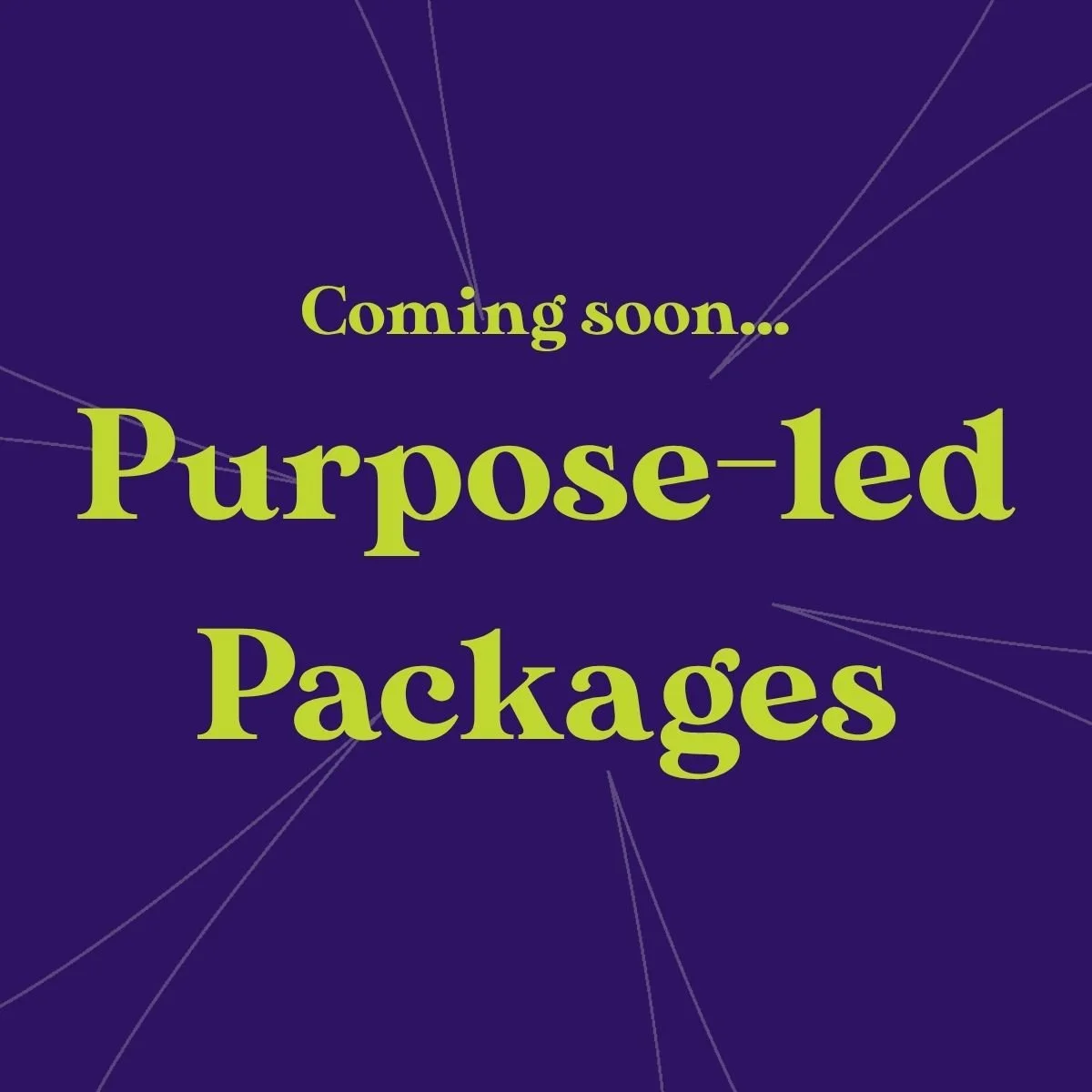
I am currently working on design packages to support my clients even more than I already do. Watch this space!
What has hating cauliflower got to do with marketing?
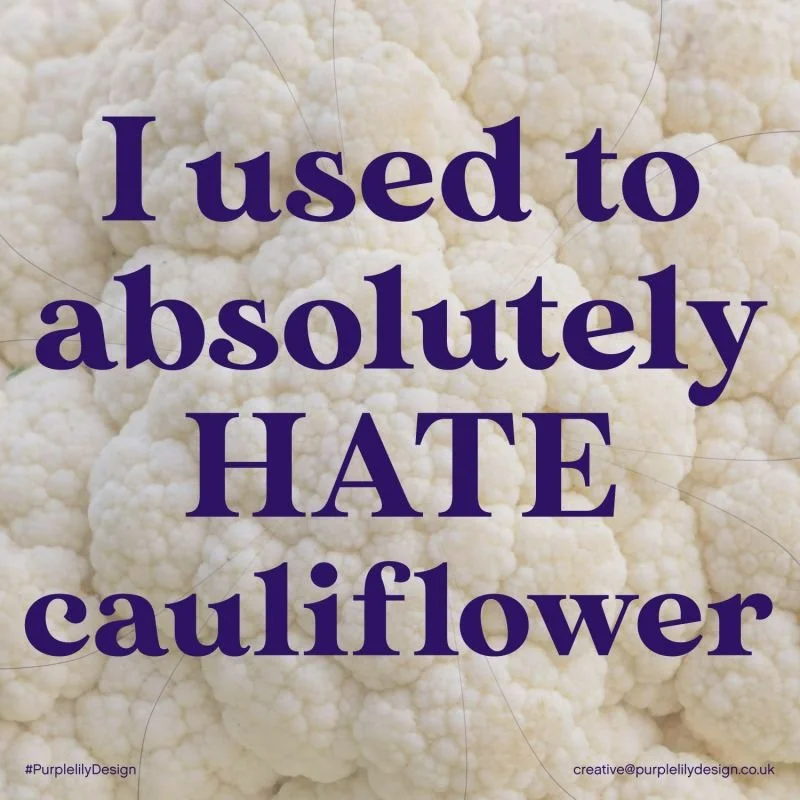
The story of how I used to hate cauliflower but chaged my approach with a different cooking method.
Yes, that’s right, I used to absolutely HATE cauliflower! Couldn’t stand it.
So what’s that got to do with visual storytelling, graphic design and marketing strategies for ethical and environmentally sustainable businesses, charities and educators?
Many of my clients and connections feel the same way about marketing, especially posting on LinkedIn. They worry about being authentic, or about 'getting it wrong', so they avoid it altogether. When that happens, I tell them my story about cauliflower, once the most hated vegetable on my plate (well, except for sprouts!).
Growing up, cauliflower was always a little bit overboiled; a soft, joyless cloud. It had no flavour, no texture, and no appeal. I assumed I hated the stuff. It took me a long time to realise that it was more about the way it was cooked. Years later, after exploring some recipes, I tried roasting it with spices and a little olive oil. Oh, my goodness, it was a revelation. One of the most delicious things I’d ever tasted. The same vegetable, completely different experience. A change in approach changed everything.
Marketing works the same way. When clients and connections start seeing it as storytelling – sharing real experiences, real values, real impact – it makes such a bloomin’ difference. Now they plant their marketing posts freely, and they even have fun doing so.
If there is something you hate about design or marketing, I can help you find a way to spice up your approach so it feels more like you. And if you know a way to make sprouts palatable to this vegetarian, I’m all ears.
The Hero’s Journey of Purplelily Design: The Translator of Complexity to Clarity
Over the past few weeks, I’ve been on a business journey like no other. In fact, it’s been the Hero’s Journey, booked through the CREATIVE SPACE COMMUNITY with tour guides Charles and Andrea.
This experience has directed me to a process I had never considered before: using AI to map out what I want and where I want to go with Purplelily Design after 20 years in business. I’ve always said I’m not against AI when used thoughtfully and responsibly, NEVER for logos or final designs. This exploration provided me with written guidance and visual strategies (while being mindful of my carbon footprint).
Starting with the basics: a degree in Graphic Information Design, more than 28 years of industry experience, and a passion for sustainability, education and thoughtful design. The search for a defined route was planned (passport and toothbrush packed).
I already had credibility, recognised design skills, trust, and values alignment. A gentle push towards becoming more of a trusted ethical communications partner helped me map out my North Star, the adventure calling me towards greater clarity and refined creative freedom.
On the Hero’s Journey, we talked about souvenirs as proof that we have travelled somewhere unfamiliar and returned changed. My souvenirs are my skills, every completed design project with a delighted client, years of relationships built, and the ability to solve problems and keep going on the business rollercoaster.
As I reached 'The Cartographer’s Realm', where I’ve spent many years helping others find clarity, direction and identity, I took time to redraw my own map. Standing on solid ground, I confirmed to my AI assistant that what energises me most deeply is designing infographics and visually accessible reports (white papers, brochures, etc).
That led me to 'The Translator’s Kingdom', where I am now ready to turn complexity into clarity, a phrase that has been used to describe my design work on more than one occasion.
The treasure has always been there. Leaning into it more makes my North Star shine brighter. My map now points towards Meaningful Impact: clear information, inspired action, greater impact. (My word of the year chosen back in January was 'impact'.)
The graphic below shows the journey my clients take from complexity to clarity → Discovery → Research and Listening → Simplification → Visual Storytelling → Accessibility Check → Delivery → Real‑World Impact.
From now on, my focus will be on creating infographics and visually accessible reports for purpose‑led businesses, charities and educators, while remaining open to all aspects of design when the need arises.
No, AI is not going to take my job. This illustration may have been generated with AI, but it took weeks to develop with me firmly at the helm. The logo, as always, is 100% human‑created and added afterwards.
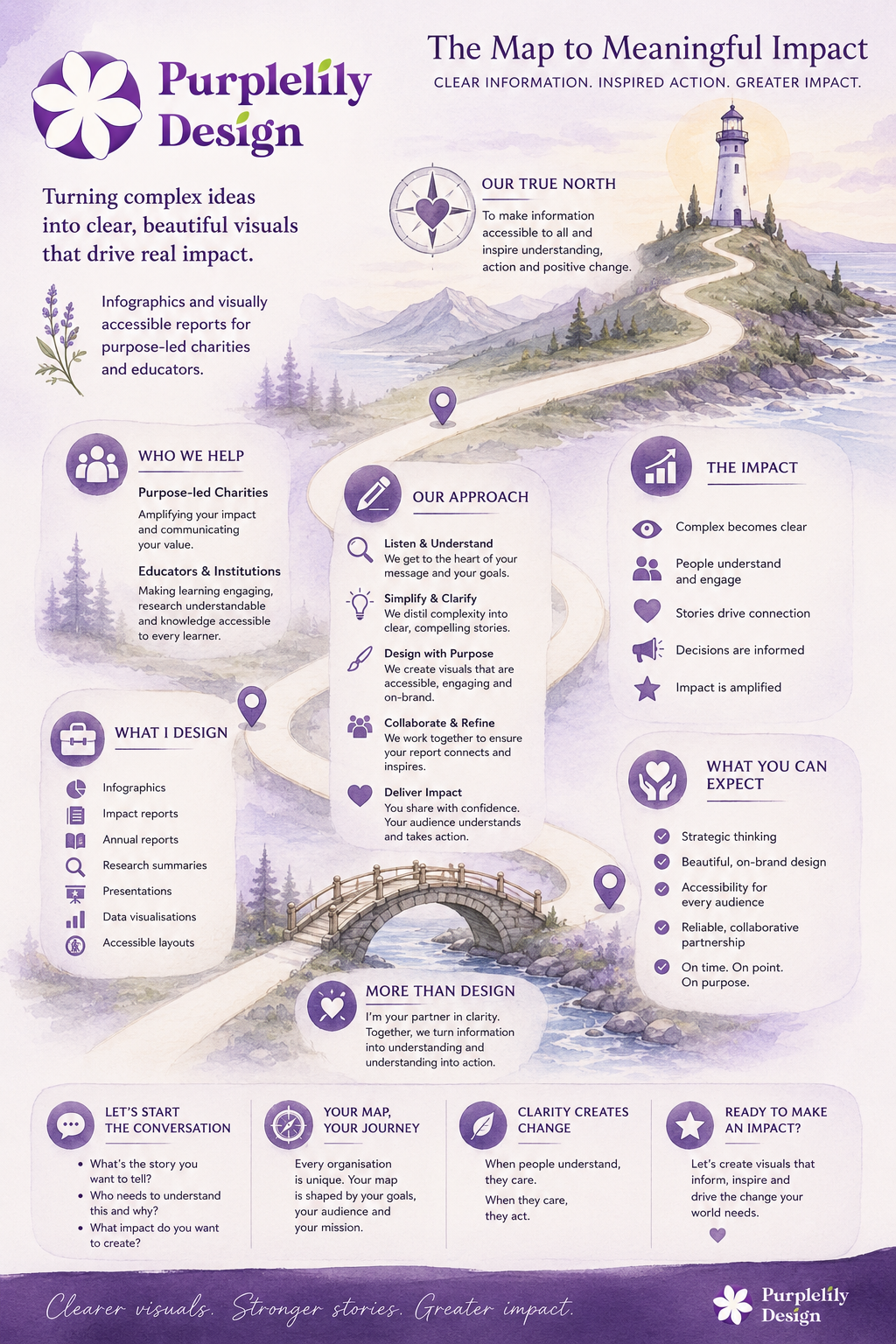
Map and artwork created using AI, logos are 100% human.
World Ocean Day 2026
Today is World Ocean Day, a day that unites millions across the globe to protect our blue planet. While every day should be Ocean Day, this one reminds us just how vital the 71% of our world covered by water truly is: for our health, our climate, and our future.
First proposed by Canada at the 1992 Earth Summit in Rio, it supports the UN Sustainable Development Goal 14: Life Below Water. This year’s theme focuses on strengthening marine protected areas. Overfishing, pollution, and rising sea temperatures continue to put our oceans under immense pressure. Yet, they give us so much in return – oxygen (mangroves, kelp forests, seagrasses, etc.), food, livelihoods, climate regulation, spiritual connection, and pure joy!
Our oceans absorb up to 30% of carbon dioxide emissions and more than 90% of the heat produced by greenhouse gases. They are the largest carbon sink on the planet and a source of life that connects us all.
But they’re under threat:
• Microplastics are found in fish and fish-eating birds
• Ocean acidification harms coral reefs and shell-forming species (turtles)
• Overfishing and illegal practices collapse marine populations
• Agricultural runoff creates 'dead zones' devoid of oxygen
• Noise pollution disrupts whale migration, and light pollution disrupts turtles
• Habitat loss increases coastal vulnerability to storms and rising seas
To meet the targets of SDG 14, we must:
• Cut marine waste and habitat destruction
• Eliminate harmful fishing subsidies
• Support sustainable aquaculture
• Advance ocean science and technology
• Expand marine protected areas (currently only around 8% of the ocean)
Since my student days in Falmouth, Cornwall, I’ve felt deeply connected to the sea. I remember sitting by a crumbling window at Pendennis Castle high above the town, gazing out over the water and thinking about the world beyond.
Exploring Spain, Tunisia, Greece and beyond, I’ve been lucky to see dolphins, turtles, and vibrant marine life in their natural homes. I’ve admired the work of Wildlife Sense as they mark nesting sites and study returning turtles. I’ve chosen not to use speedboats or take part in water sports activities that could harm sealife, discouraged the taking of shells from beaches: take nothing but pictures, leave nothing but footprints, and kill nothing but time. I’ve loved hearing how charities and businesses collaborate to reuse ghost fishing nets, turning them into flooring through initiatives like Interface.
The real treasure isn’t buried in a chest on the seabed. It’s the ocean itself and the life it sustains. Let’s protect our blue planet while we still can.
💙 What small action will you take today to help protect our oceans?
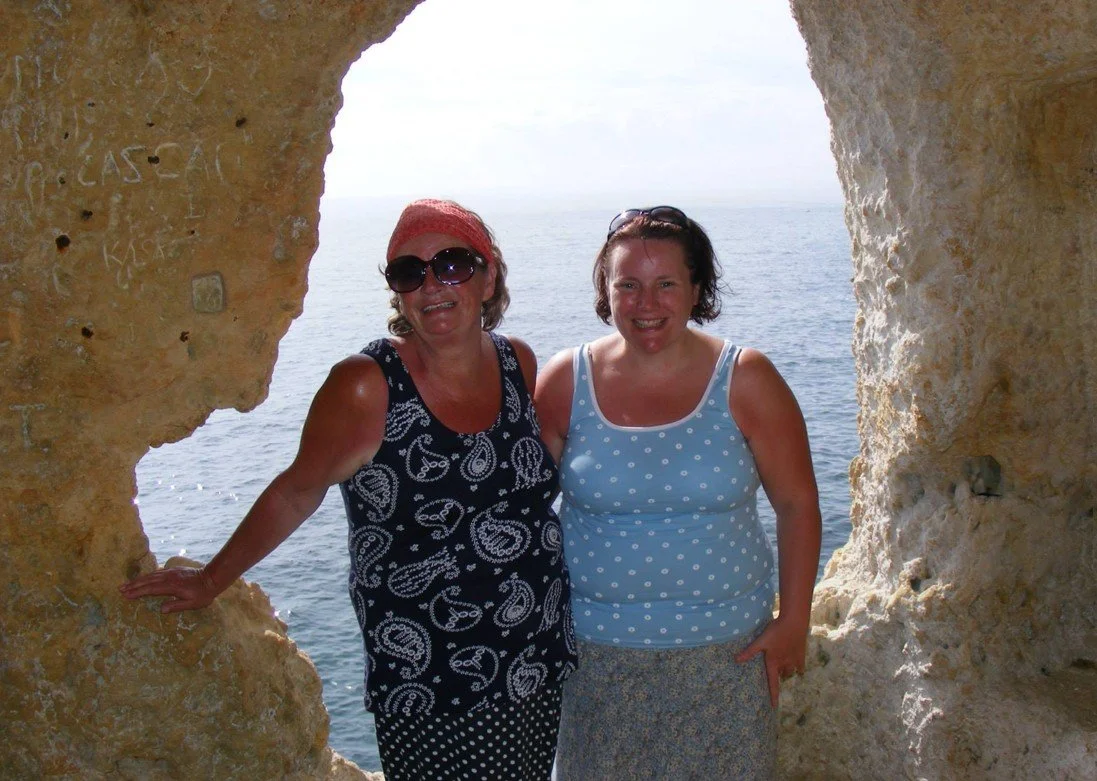
Tracy, founder of Purplelily Design, on her travels around Portugal with her mum.
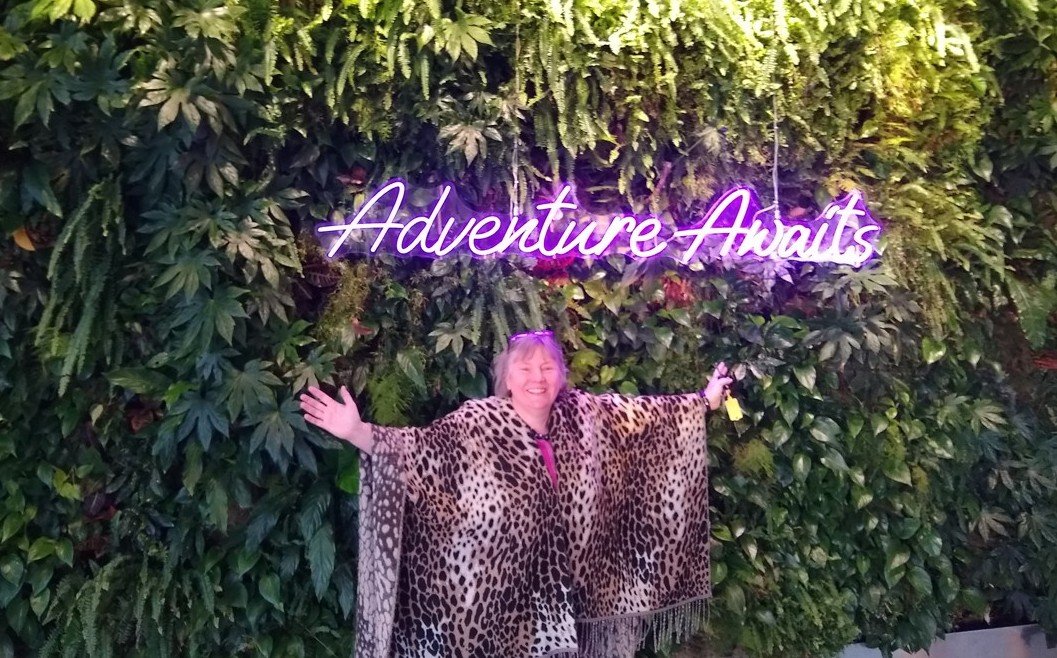
Guest Editor for the Association of Sustainability Practitioners' newsletter
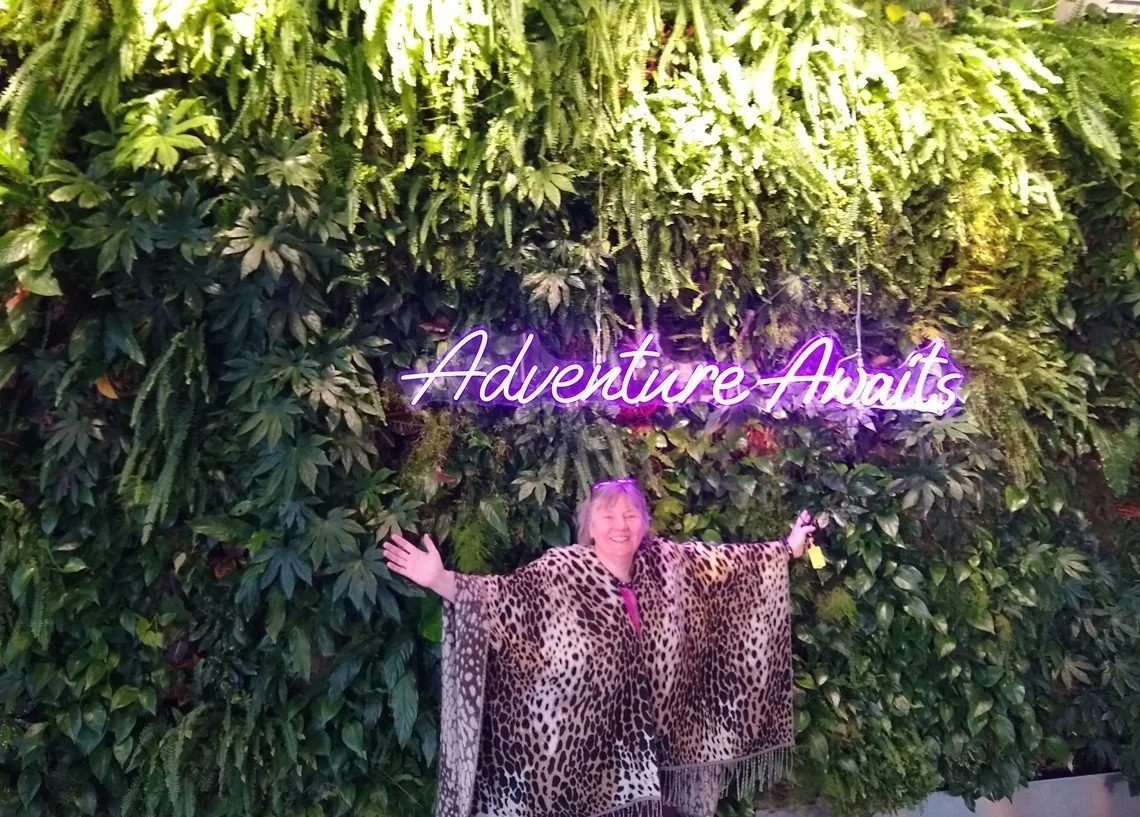
Tracy (me) standing in front of a gorgeous living wall at Portsmouth Port. The Port is implementing a range of ambitious sustainability measures aimed at becoming the UK's first zero-emission port by 2050 and achieving carbon net-neutrality by 2030.
I hope you are enjoying your Bank Holiday weekend. I’m writing to you from a hot Hampshire, UK, although I am sitting in the coolest room of my home with Newton (one of many rescue guinea pigs I've adopted over the years), as the garden swelters in 29 degrees. This time last week it was almost winter.
As ASP members, I’m sure we’re all aware that climate change leaves us open to extremes in weather patterns, and the UK has gone from unseasonably cold to unseasonably hot in a couple of days. I’ve been a member of ASP for (almost) a couple of years, after meeting Elder Gwyn Jones and fellow member Nick Whitnell at the launch of People, Planet, Pint in Poole, Dorset.
Condensing down my purpose for being here, I’m not a scientist, or a consultant (in sustainability anyway), but a graphic designer with both feet firmly planted in the natural world. As a child, I loved nature, plants and animals (hedgehogs and dormice weren’t as rare as they are now). I also loved watching David Attenborough with my late nan, when we weren’t rescuing spiders from my mum. As a teenager, I had the most inspirational Geography and Environmental Science teachers. I campaigned locally, took part in the Greenpeace Walk for Whales, and had the difficult decision to choose a career path that mattered.
A degree in Graphic Information Design took me to the stunning coast of Cornwall and showed me that I could use my skills to make a difference; design isn’t just about selling stuff people neither want nor need. Information Design can help to instruct and advise when so many are overwhelmed and need an accessible approach, especially when translating complex environmental issues.
After eight years working in agencies where I had no control over who I worked for, I created my solo business, Purplelily Design, which is now 20 years old! A love of colour and nature inspired me to choose my own path and my own values: integrity, accountability, transparency, sustainability and creativity among them.
As my LinkedIn profile states, I create graphic design and marketing strategies for ethical and environmentally sustainable businesses, charities, and educators. I love working with purpose-led organisations of any size, anywhere in the world, that care about how they operate. They value their people, their supply chain and impact. I get to learn amazing stuff in the process.
I’ve supported charities working in homelessness, health, wellbeing, additional needs, animal rescue, education, nature and environmental issues. I’m especially drawn to animal and nature-based charities and love helping them communicate their work with clarity and heart. I’ve also volunteered at an education centre, sharing with visitors about animal welfare when travelling abroad, as well as the practicality of exotic pets (e.g. research on where snakes and reptiles originate, the TLC they need and that they can live for a long time). This is also where I was educated that people matter when working to make a positive impact; a four legs good, two legs bad approach doesn’t work!
In many ways, we are all educators. Learning is a lifelong process, and I have spent most of my design career creating for educators, having also worked within a university. With nearly 30 years of experience, I educate my clients and save them time and money whilst ensuring that projects move smoothly and efficiently to create long-lasting solutions.
As well as being a member of ASP, I’m also an active member of ORB (currently taking part in their Environmental, Social, and Governance course), Creative Space (currently taking a ride on the Heroes' Journey), and business and creative networks locally and internationally. I’m inspired by the business stories of ASP founder Anita Roddick’s The Body Shop, Ray Anderson (Interface), Dorothy McKenzie (author, educator and former agency director) and all those working in business while making a positive impact.
I am always looking to help new clients and causes, so if you know a purpose-led business, charity or educator who would benefit from thoughtful, ethical, accessible design, I’d love to have a chat.
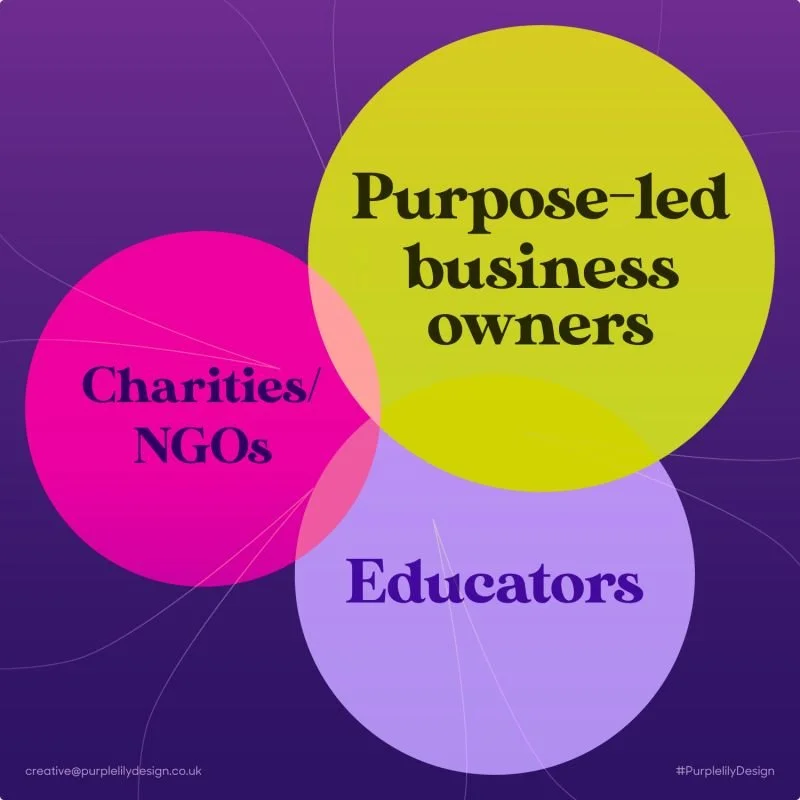
Purplelily Design’s ideal clients are charities/NGOs, Purpose-led business owners, and educators.
Green Business Networking
This blog was originally written for and posted on the Green Hampshire website.
Many years ago, when I was a student in Falmouth, Cornwall, I had to complete work placements as part of my course in Graphic Information Design, one of which introduced me to Dorothy Mackenzie, author of Green Design: Design for the Environment. This really inspired me and has had a long-lasting influence on my way of thinking. My dissertation was based on advertising campaigns created by NGOs and environmental organisations, and my major design project focused on the logistical issues of recycling in Cornwall and included posters with the headline ‘everything has the potential to be something else’ (1997).
As I’ve always had a great passion for design as well as anything that is ‘green’, it made perfect sense to combine the two with the work I create as a freelance graphic designer. It’s why Purplelily Design was created back in 2005, to nurture businesses with similar values.
As a freelance graphic designer, I do a lot of networking in Hampshire (and sometimes Dorset and Wiltshire); part of Purplelily Design’s ethos is to work with and support local businesses. This has taken me to events organised by the University of Winchester, where I heard Jonathon Porritt* present (twice), The Big Green Event, The Big Green Breakfast and the Hampshire and Isle of Wight Sustainable Business Network events.
*Forum for the Future and formerly of the Green Party and Friends of the Earth.
The first Big Green Event, in October 2016, introduced me to the organisers Lynda Daniels and Anita Potten, also of the Southern Sustainability Partnership. The breakfast events they organise in Hampshire and Dorset have, so far, included talks by the Head of Energy and Environment at University of Winchester, who talked about an increase in student numbers and a decrease in resources as well as engaging students in big ‘switch offs’ at the University; Peter Schofield, Environment Manager at GEP Environmental Ltd, who talked about ISO 14001:2015 updates and 918 Coffee who talked about using spent coffee beans.
The Environmental Management Conference (April 2017), held at the Ageas Bowl, introduced me to the Circular Economy, Cradle2Cradle production, and so much more! The whole day encouraged me to support sustainable businesses and promote my business values more, as we all need to ‘shout louder’ about all the good things we do.
• Adam Woodhall, Inspiring Sustainability, brought his own knowledge and experience on sustainability and a flourishing economy.
• Ken Webster, from the Ellen MacArthur Foundation, talked about the Circular Economy, as well as an incredible list of books that included A Wealth of Flows: Circular Economy.
• IEMA talked about the British Standards Institute’s BSI 8001 and its relation to ISO14001, the Environmental Management System.
• Sustainable Procurement gave us a fun task to see how we would buy office furniture on budget and on brief for a sustainable business.
• Jason Light, Environmental Lead at Eastleigh Borough Council, talked about projects using Solar PV, LED Lighting, Electric Vehicles, and Bike to Work Scheme, to name a few.
• Jonathan Lodge, City Farm Systems, talked about how City Farm Systems installations (produce grown at source on a rooftop plot) can allow suppliers to save on wastage, transport, packaging and pollution.
• Pearce Compaction Systems showed how waste can be reduced and that they have a solar-powered compactor installed at Windsor Castle.
• Tom Old and Karl Walker, Clean Energy UK, talked about their time with Al Gore in the Philippines and the 2015 Paris Climate talks.
The winner of the Conference competition was from the Mayflower Theatre, and they won an electric bike from Richard Davies of FreeGo Electric Bikes (Southampton).
Events held by the Hampshire and Isle of Wight Sustainable Business Network (Formerly SBN Solent) have included Marketing Sustainability, Sustainable Workplaces, Sustainable Transport and Corporate Social Responsibility (CSR).
• At the CSR breakfast in July, John Buckley, Carbon Footprint Ltd, talked about CSR on a shoestring. CSR can have a positive or negative impact on a brand… “It takes 20 years to build a reputation and five minutes to ruin it. If you think about that, you’ll do things differently.” Warren Buffett. CSR is important for all organisations and is more than just giving to charity. It’s also about taking responsibility for ethics in an organisation, large or small.
• Community Matters talked about a purpose beyond profit, which included fundraising and employee volunteering. Members of the Community Matters partnership include the BMW Group UK, TAG Farnborough Airport and the Sixth Form College Farnborough.
• De La Rue talked about their Code of Business Principles – doing the right thing, which includes: health, safety and the environment; fairness and respect; records and reports; conflicts of interest; protecting personal information, competition and anti-trust laws; bribery and corruption; gifts and hospitality; insider trading and confidential information; anyone who raises a concern in good faith will be fully supported. They also assured us that De La Rue does not produce the new plastic five-pound notes that use animal tallow in production!
New Forest Tartan I recently met Kate Collison of New Forest Tartan at the New Forest Business Partnership networking breakfast, just before the New Forest Show. New Forest Tartan is a new business that uses British, plant-dyed wool, hand-woven in a blend of oak, yew, silver birch, heather and fern colours.
Oh, and I mustn’t forget the lovely Suzii Fido of Marketing with Ethics, whom I met at a Business Builder’s breakfast in Fareham a couple of years ago. Suzii also runs a Facebook group called Ethical Marketing for Business with her husband. Business and Facebook pages are now run remotely from the beautiful island of Kefalonia, where they also help Wildlife Sense, supporting local turtles.
See you at The Big Green Event in October to check out what’s new with Tesla and other sustainable businesses! There really is so much going on, time to ‘shout louder’, everyone, make your sustainable business stand out!
——
Since writing this article, I have also attended the launch of Southampton City Council’s Clean Air Network and Sustainable Cities. More will follow after the next Big Green Event on the 2nd October 2018. See you there!
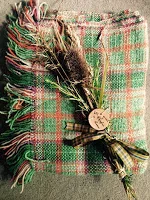
© New Forest Tartan
Banner image credit: Kier in Sight Archives, Unsplash